Most of what is written about art in the home is decoration advice. This is not that. There is now a real body of research on what looking at art does to a person, and it is stronger than we expected when we went digging. Here is what it says, with the receipts, and what it means for the four walls you spend your life inside.
What the studies actually found
In 2019 the World Health Organization published a scoping review by Daisy Fancourt and Saoirse Finn that gathered evidence from over three thousand studies and concluded that the arts play a major role in preventing ill health and supporting wellbeing across a lifetime. That includes what researchers call receptive engagement. Just looking counts.
Zoom into visual art specifically and the picture holds. A 2021 review in BMJ Open examined fourteen studies of people passively viewing artworks. Thirteen of the fourteen found reductions in self-reported stress, and every study that measured systolic blood pressure found it fell. In one small London pilot, city workers who spent a 35 minute lunch break in a gallery walked out with less cortisol, the stress hormone, than they walked in with.
Your brain on a painting it loves
At University College London, the neuroscientist Semir Zeki put people in a scanner and showed them paintings they had rated beautiful. The 2011 study found that beauty, whether seen or heard, activates the medial orbitofrontal cortex, a core part of the brain’s pleasure and reward system. Zeki has described it as the same reward circuitry engaged by romantic love. Note what the scanner does not care about: whether the painting is famous. It cares whether you find it beautiful. The benefit belongs to your taste, not to the canon. We built a whole company on that sentence.
You do not need the museum
The newest and maybe most useful finding is that none of this is locked inside galleries. A 2025 systematic review of 38 studies covering 6,805 people found that viewing visual art improves not just mood but eudaimonic wellbeing, the researchers’ term for meaning in life, and that the effects show up in museums, hospitals and on screens alike. In an earlier experiment, three minutes with Monet’s water lilies, viewed online, improved mood and anxiety. Three minutes. A wall you pass forty times a day has more chances than that.
Two more pieces complete the picture. A 14 year study of 6,710 older adults found that even occasional engagement with the arts was linked to living longer, an association that survived controlling for wealth and health. And at the University of Exeter, psychologists found that spaces enriched with art made people around 15 percent more productive and noticeably more comfortable, and that the gains roughly doubled when people chose and arranged the art themselves. Choosing your own, it turns out, is not a detail. It is the active ingredient.
What we are not claiming
Nobody has run a randomized trial on owning paintings. We looked. The mortality finding is an association, not a mechanism, and the lunchtime cortisol study had 28 people in it. What the research supports is a chain: looking at art you find beautiful does something real and measurable, the effect is not confined to any venue, and environments you shape yourself do it best. A home is simply the place where all three overlap, every single day.
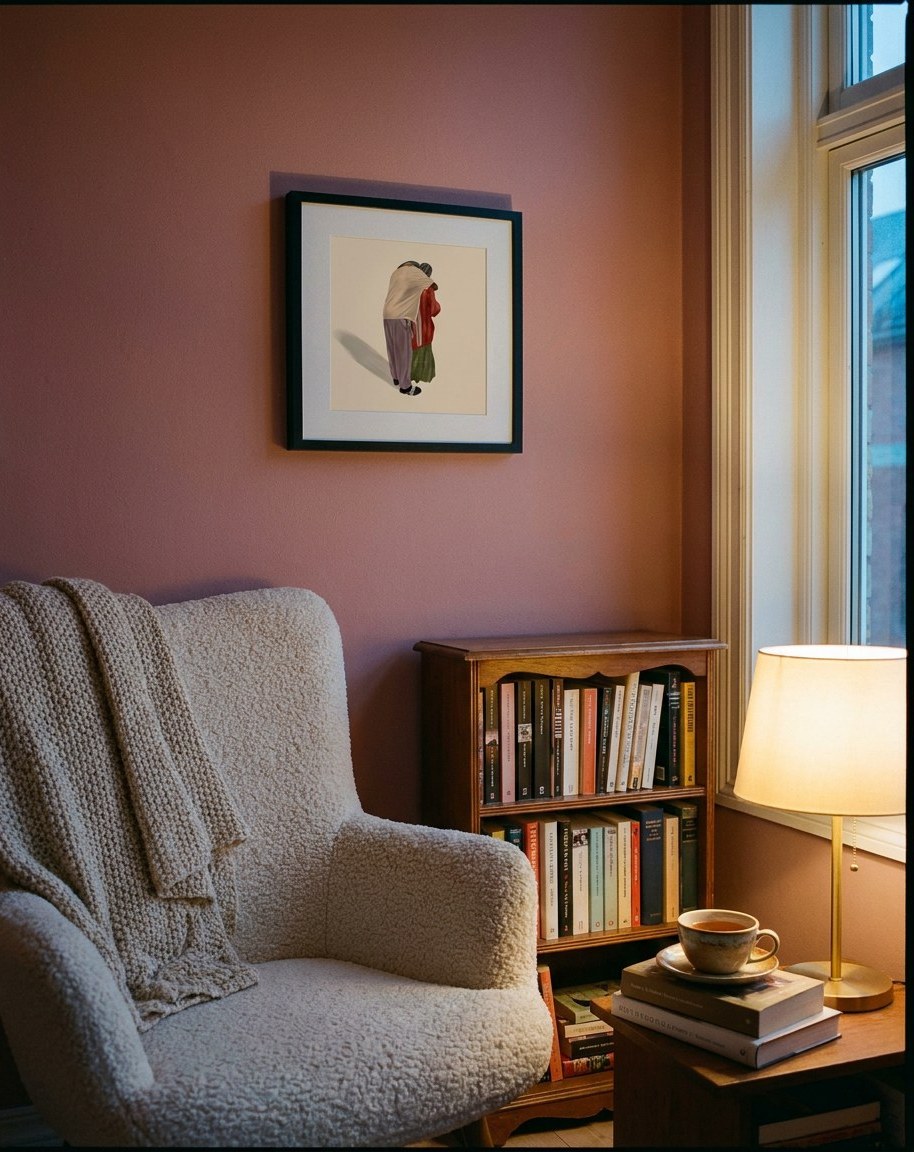
Doctors in our home city have been acting on this logic since 2018, when the Montreal Museum of Fine Arts became the first museum in the world where physicians could prescribe visits. We would only add: the museum closes at five. Your walls do not. If you want to find out what your version of beautiful is, that is exactly what the style quiz is for.